

Welcome to our 2024 Impact Report – a look at what our portfolio companies have done to move the needle. This year’s edition highlights the grit, progress and potential of impact startups in a world that feels anything but predictable. It’s a snapshot of where we are, what we’ve learned, and why we believe the case for impact has never been stronger.
Every drug, material, or agrochemical starts with the same challenge: you need a molecule that doesn’t exist yet. And still today, making that molecule is painfully slow. Chemists spend weeks synthesising compounds before discovery work can even begin. In a world where AI is transforming biology, chemistry remains one of the biggest bottlenecks.
That’s why we’ve invested in Onepot.
The Problem
Small-molecule discovery is the foundation of modern medicine, materials, and agriculture. But the process of actually making new compounds hasn’t kept pace.
A typical pharma team waits months just to receive a handful of molecules. Most synthesis projects fail on the first attempt. And even when reactions do work, the knowledge often doesn’t transfer. Every project starts from scratch, relying on decades-old procedures locked behind paywalls – with limited data on what didn’t work.
Chemistry also has a structural data problem. There are an estimated 10⁶⁰ drug-like molecules in theory, yet only a tiny fraction have ever been synthesised. Public datasets are small. Industrial datasets are fragmented. And to this day, chemists are still mixing reagents by hand, often relying on intuition and hope. Which means progress stalls before discovery even begins.
For AI-driven drug development to truly take off, synthesis can’t stay stuck in the past.
The Solution
Onepot built a different kind of lab.
They combine artificial intelligence and robotics to automate one of the most time-consuming steps in drug development: chemical synthesis.
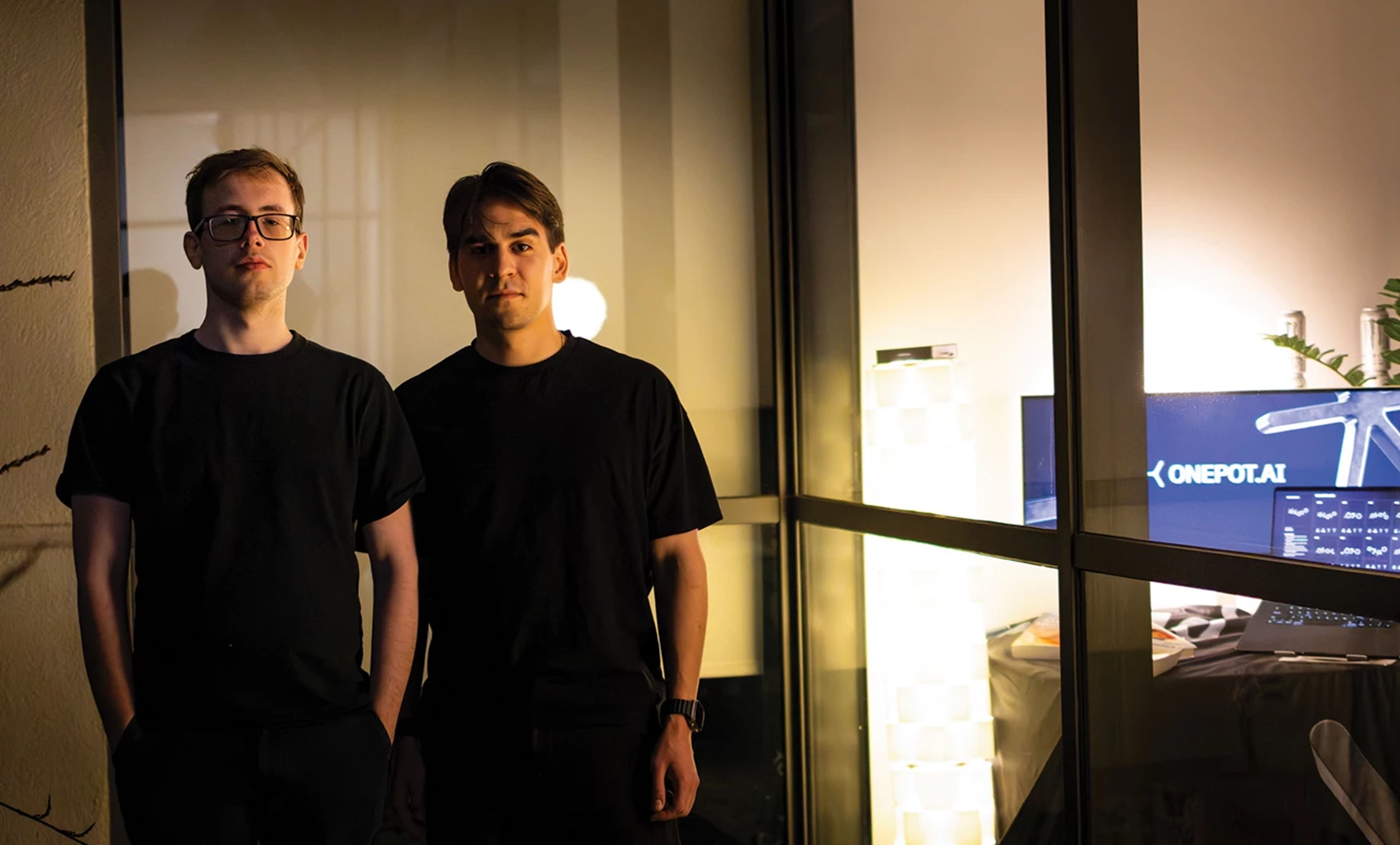
Onepot was founded by Daniil Boiko and Andrei Tyrin, who first met in a chemistry lab at Moscow State University. After moving to the US – Boiko to Carnegie Mellon, Tyrin to MIT – they reconnected around a shared frustration: chemists were spending more time trying to make molecules than actually discovering them.
That insight became the starting point for Onepot: a lab where synthesis is no longer the bottleneck, but the engine.
Chemists begin by submitting a target molecule – or selecting one from Onepot’s digital library of 3.4 billion possible compounds, most never synthesised before. From there, their AI model, Phil, takes over.
Trained on in-house experimental data and published literature, Phil designs the synthesis route: what reagents to use, what steps to follow, what conditions to test. Then robots in the lab execute the experiments in the real world.
Phil can write protocols, operate lab tools, analyse LC/MS results, detect byproducts, and design new experiments on the fly. In just one month, Phil runs more reactions than a typical graduate student would during an entire PhD.
Early commercial partners are already receiving new molecules 6–10x faster, eliminating one of the biggest bottlenecks in small-molecule discovery.
The Round
Onepot has raised $13 million in funding from Fifty Years, Khosla Ventures, Speedinvest, Norrsken VC, and Script Capital – with support from Agata and Wojciech Zaremba (co-founder of OpenAI), Jeff Dean (Chief Scientist at Google), NAVEC, and others who believe AI’s next frontier is not chatbots, but atoms.
We’re proud to back Daniil, Andrei, and the Onepot team as they build the infrastructure that will make drug discovery faster, cheaper, and dramatically more scalable.


